Descriere
Sumar
Despre autori
Online edition, open access here.
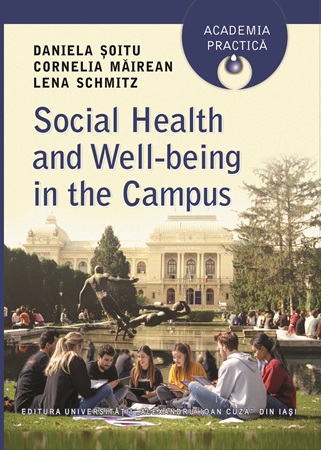
This book explores the multifaceted dimensions of health, resilience, and well-being in contemporary university environments. The volume integrates perspectives from sociology, psychology, public health, social work, and organizational health to develop a holistic understanding of student well-being. It presents current theoretical models of mental health, social health, health literacy, and resilience and examines the risk and protective factors that shape students’ experiences. The book includes extensive empirical evidence from comparative studies conducted at Friedrich Schiller University Jena (Germany) and Alexandru Ioan Cuza University of Iași (Romania). It analyzes academic, social, environmental, and organizational determinants of health and well-being on campus. Particular attention is given to the Healthy Campus approach and evidence-based interventions for promoting student flourishing. The volume combines scientific rigor with practical applicability through activities, self-assessment tools, and intervention exercises. It also highlights innovative educational initiatives developed within the EC2U European University Alliance. Addressing students, researchers, and practitioners, the book offers valuable insights for creating supportive and inclusive university communities. Overall, it provides a comprehensive framework for understanding and enhancing social health and well-being in higher education settings.
The main findings show that the students are more likely to thrive when they feel connected, valued, and included within the university community. Social connectedness should therefore be treated as a strategic component of student success, supported through peer relationships, inclusive practices, collaborative learning, supportive environments, and active participation in campus life. Student health and well-being should be viewed as a shared responsibility of individuals and institutions. Effective promotion of social health requires integrated interventions that address academic, psychological, social, organizational, and environmental factors simultaneously. The Healthy Campus model emerges as a promising framework for creating sustainable, supportive, and resilient university communities.
I. Conceptual Framework
I.1. Why Social Health in the Campus?
I.2. The dual-continua model of Mental health
1.3. The prevalence of mental health difficulties among students
I.4. Risk and protective factors
I.5. Implications of previous results and interventions
I.6 The psychological point of view in a Healthy Campus concept
II. Studying Health and Well-being in the Campus: Methodological Approaches
II.1. Defining health in the university context
II.2. Biopsychosocial model and the salutogenesis
II.3. HOPES – Healthy Organization, Person and Environment System Model
II.4. Instrument Construction and Application
II.5. Sample Description from University of Jena
II.6. Sample description from UAIC University
III. Results of Study Cases in Germany and Romania
III.1. Healthy Campus Results: German Survey 2024
Organization 1: Study Programme
Organization 2: Environment & Equipment
Organization 3: Culture
Organization 4: University Offers & Interventions
Person 1: Satisfaction, Resources, Qualification, Well-being and Health
Person 2: Mental & Physical Health
Person 3: Health attitude & health behavior
Person 4: Resilience, health literacy, coping & Well-being
Mobility (road traffic & university paths)
III.2. Healthy Campus Results from UAIC Survey, 2025
Organization 1: Study Programme
Organization 2: Environment & Equipment
Organization 3: Culture
Organization 4: University Offers & Interventions
Person 1: Satisfaction, Resources, Qualification, WLB & Health
Person 2: Mental & Physical Health
Person 3: Health attitude & health behaviour
Person 4: Resilience, health literacy, coping & Well-being
Mobility (road traffic & university paths)
Survey Feedback
III. 3. Conclusion and further challenges
IV. Practical activities for Social Health and Well-being in Campus
Activity 1. Assessment of academic stress
Instructions
A. Academic workload
B. Time management
C. Academic performance pressure
D. Social and personal balance
Activity 2. Stress responses
Activity 3. Stress experience and resource identification
Activity 4. Use your personal resources that can enhance your well-being!
Activity 5. Solve technique
Activity 6. Happiness is a choice
Activity 7. How to invest in Social Health and Wellbeing in Campus for a week: BIP Agenda
Activity 8. How to be prepared for a wonderful experience in UAIC Campus – BIP Virtual sessions
Daniela Şoitu is a professor at “Alexandru Ioan Cuza” University of Iaşi, Faculty of Philosophy and Social-Political Sciences, Department of Sociology, Social Work and Human Resources. Her professional journey is grounded in social and educational fields, on health policies, and interdisciplinary research in the social. Dr Şoitu approached complex theoretical perspectives with practical insights, fostering both academic and professional collaboration. She is the coordinator of the “Lifelong Well-being and Healthy Ageing” Master program (LIFELINE) in the EC2U University Alliance, a “lego-like” Joint Master Program involving up to 9 universities. She co-coordinate a new master program “Well-being, Resilience and Social Risks” at UAIC. D. Şoitu’s is the scientific coordinator of the EC2U Virtual Institute for Good Health and Well-being (GLADE) and the Editor in Chief of the journal Scientific Annals of UAIC. Sociology and Social Work. Her innovative strategies have enriched the academic environment, enabling the effective examination of contemporary educational, social and political challenges. Her publication record includes contributions to leading journals and collective volumes, covering key topics in social sciences, social health, well-being and policy analysis.
Cornelia Măirean is a Professor PhD at the Faculty of Psychology and Educational Sciences, Alexandru Ioan Cuza University of Iași. Her research interests include stress and exposure to traumatic events, recovery and posttraumatic growth, and the mental health implications of high-risk situations. She has published, as author and co-author, books as well as studies in edited volumes and journals indexed in Web of Science. Among her representative works are Trauma Psychology (co-authored, 2014, 2025), Quantitative Research Methods: Designs and Applications in the Social Sciences (coordinated, 2022), and The Psychology of Morality: Theoretical Perspectives and Practical Implications in Adverse Life Conditions (coordinated, 2024).
Lena Schmitz is a PhD candidate in Work, Industrial and Organizational Psychology at the Faculty of Social and Behavioural Sciences at University of Jena, Germany. With a focus on organizational health and intercultural perspectives, her research explores the intersection of cultural, individual and structural factors in academic, educational and organizational contexts. Lena Schmitz has contributed to interdisciplinary research projects addressing health competence, workplace well-being and the development of sustainable health management strategies within higher education institutions, with particular attention to the role of institutional structures in shaping health-promoting environments. Her work reflects strong interest in generating empirically grounded insights to promote sustainable improvements in academic and organizational settings. In the long term, Lena Schmitz is committed to translating research findings into practical, context-sensitive interventions that strengthen organizational resources, support well-being and foster inclusive health promotion practices in participatory approaches.