Descriere
Sumar
Despre autori
[ENG]
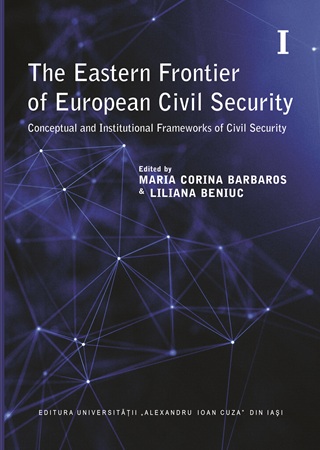
The Eastern Frontier of European Civil Security examines how civil security is changing at the eastern frontier of the European Union. The context is one of overlapping crises: Russia's war against Ukraine, energy vulnerability, disinformation, corruption, institutional fragility and democratic distrust. The book starts from the premise that civil security is not merely a technical component of national security. It is a public good, built through trust, credible institutions, democratic accountability and societal resilience. The first volume sets out the conceptual and institutional frameworks of the subject. These include the shift from state-centric to human security, the relationship between security and identity, political discourse and strategic communication, EU diplomacy, local governance and the role of non-state actors. Developed within the SECURE-MD research grant (UEFISCDI), the work brings together scholars from Romania and the Republic of Moldova. It is written for academics, policymakers and practitioners concerned with resilience and democratic governance on Europe's eastern flank.
[RO]
Monografia The Eastern Frontier of European Civil Security analizează transformarea securității civile la frontiera estică a Uniunii Europene. Contextul este unul al crizelor care se suprapun: războiul Rusiei împotriva Ucrainei, vulnerabilitatea energetică, dezinformarea, corupția, fragilitatea instituțională și neîncrederea democratică. Lucrarea pornește de la premisa că securitatea civilă nu este o simplă componentă tehnică a securității naționale. Ea este un bun public, construit prin încredere, instituții credibile, responsabilitate democratică și reziliență socială. Primul volum propune cadrele conceptuale și instituționale ale temei. Printre acestea se numără trecerea de la securitatea centrată pe stat la securitatea umană, relația dintre securitate și identitate, discursul politic și comunicarea strategică, diplomația UE, guvernanța locală și rolul actorilor nestatali. Rezultat al grantului de cercetare SECURE-MD (UEFISCDI), volumul reunește cercetători din România și Republica Moldova. Se adresează mediului academic, factorilor de decizie și specialiștilor interesați de reziliență și guvernanță democratică pe flancul estic al Europei.
Introduction
From State-Centric Security to Human Security: Accountability, Sovereignty, and Some Contemporary Challenges
Bogdan Ștefanachi
Security and Identity - Tension, Interdependence and Complementarity
Bogdan Constantin Mihăilescu
Criminological Resilience as a Conceptual Foundation of Civil Security in the Eastern European Space
Vitalie Ionașcu, Beniamin Lup
Political Discourse as a Civil Security Instrument: Strategic Communication, Democratic Resilience and Narrative Contestation at the EU's Eastern Frontier
Aurelia Peru
Corruption as Insecurity in Post-Communism
Corneliu Bîlbă
The Role of EU Diplomacy in Strengthening Civil Security and Institutional Resilience in the Republic of Moldova
Liliana Beniuc
Digital Diplomacy and Information Security in EU–Moldova Cooperation
Ana-Maria Andronache
Strategic Management and Forecasting as Instruments of Civil Security and Institutional Resilience in the Republic of Moldova
Liliana Beniuc, Dumitru Popilevschi
Non-State Actors and Civil Security Governance in the Republic of Moldova: Societal Resilience at the EU's Eastern Frontier
Liliana Beniuc, Carolina Budurina-Goreacii
Implementation of European Civil Security Standards at the Level of Local Public Administration in the Republic of Moldova
Olesea Moiseev
The New Cohesion Policy of the European Union and Its Implications for Civil Security and Social Resilience in the Republic of Moldova
Tatiana Spătaru, Vladimir Sterpu
Adaptive Leadership, Institutional Resilience and Civil Security Capacity-Building in the Republic of Moldova in the Context of European Integration
Irina Ceacîr
Migration Management and Border Control: The European Union's Strategic Response to Contemporary Refugee Challenges
Elena Simona Vrânceanu
Maria Corina Barbaros is an Associate Professor at the Alexandru Ioan Cuza University of Iași, Romania, within the Department of Political Science, International Relations, and European Studies. She holds a PhD in Political Science, and her research explores security culture, public opinion, crisis and strategic communication, and the impact of AI on discursivity. She is the director of the research grant SECURE-MD: The Contribution of the EU and Romania to Civil Security in Moldova: Policies, Strategic Partnerships, and Reinforcement of European Identity (2025–2027, UEFISCDI). Corina BARBAROS has served as the Chair of the AGORA International Conference, hosted by Alexandru Ioan Cuza University of Iași since 2025. ORCID Profile: https://orcid.org/0000-0002-6304-8525
Liliana Beniuc is an Associate Professor in the Department of International Relations at Moldova State University, Chișinău, Republic of Moldova, and a Coordinating Scientific Researcher at the Institute of Legal, Political and Sociological Research. She holds a PhD in Political Science, and her research focuses on European integration, EU foreign and security policy, international relations, diplomacy, European identity, and the Republic of Moldova’s European integration process. She coordinated the Jean Monnet Module EU Economic Diplomacy as an Instrument of Foreign Policy Action(2020–2023) and served as Chair Holder and coordinator of the Jean Monnet Chair EU’s Role in the Emerging International System (2023–2026). She is also Co-Director of the SECURE-MD project, The Contribution of the EU and Romania to Civil Security in Moldova: Policies, Strategic Partnerships, and Reinforcement of European Identity (2025–2027). Her academic work includes monographs, university course materials, and numerous scholarly publications on the European Union, international relations, security, and Moldova’s European integration. ORCID Profile: https://orcid.org/0000-0002-1094-2662